Best Air and Sea Cargo Services for Importing Goods to Indonesia (2026 Comparison Guide)

Choosing the right cargo service for importing goods to Indonesia is one of the most consequential decisions an SME owner or first-time importer can make. Get it wrong, and you're looking at surprise customs bills, delayed shipments, and communication gaps that eat into your time and margins.
This guide covers what actually matters when evaluating air and sea cargo services for Indonesia imports then looks at how different types of providers hold up against those criteria, so you can make a confident, informed decision.

What to Look for in a Cargo Service for Importing to Indonesia
Before comparing any provider, it helps to have a clear framework. Here are the seven criteria that matter most for importers shipping into Indonesia.
1. Pricing Transparency (All-In vs. Hidden Fees)
This is where a lot of importers get burned. A provider quotes an attractive base rate, then tacks on customs handling fees, import duties, local delivery charges, and documentation fees at the end. By the time your goods arrive, the final bill looks nothing like what you were originally quoted.
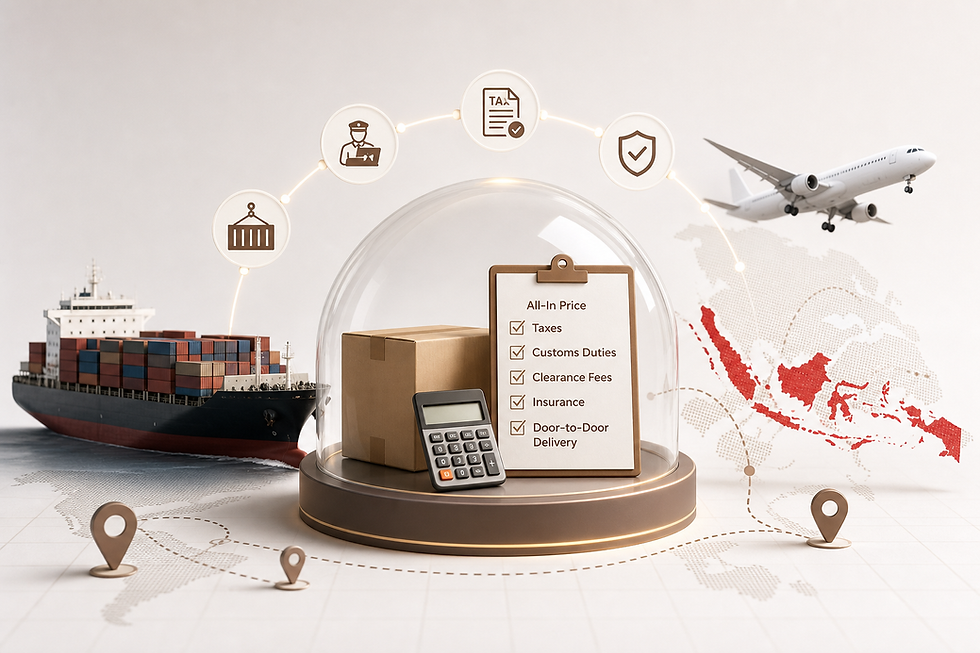
For Indonesia specifically, this is a bigger issue than in most markets. Indonesian imports involve multiple cost layers: import duty (bea masuk), Value Added Tax (PPN), and in some cases Income Tax Article 22 (PPh 22). A provider that bundles all of this into a single upfront price saves you from a very unpleasant surprise at the finish line.
2. Minimum Shipment Size
Large freight forwarders often set minimum thresholds by weight, by container volume, or both. For SMEs ordering sample batches, small restocks, or testing a new product line, a provider that accepts any shipment size is far more practical than one that requires you to fill a full container before they'll take your business.
3. Customs and Tax Handling
Customs clearance in Indonesia means navigating Bea Cukai procedures, which can route your shipment through jalur hijau (green channel, minimal inspection), jalur kuning (yellow channel, document check), or jalur merah (red channel, full physical inspection). A provider that handles this end-to-end, including preparing the correct documentation, significantly reduces your risk of delays and penalties.
4. Insurance Coverage
Cargo insurance isn't optional for international shipments. Goods can be damaged, lost, or delayed at sea or in the air. Some providers include basic coverage; others charge extra or leave you to arrange it yourself. Know exactly what's covered before anything leaves the warehouse.
5. Communication Channel and Responsiveness
For Indonesian SME importers, WhatsApp is the practical standard for business communication. A provider offering real-time WhatsApp support means you can get answers fast, track your shipment, and resolve issues without waiting on email threads or navigating a call center queue.
6. Transit Time
Air freight from China to Indonesia typically takes 3 to 7 days. Sea freight runs longer generally 7 to 21 days depending on the origin port and routing. The right choice depends on your product type, urgency, and budget. A good provider gives you realistic transit estimates, not best-case scenarios.
7. Warehouse Network
A provider with warehouses in key origin countries lets you consolidate shipments, reduce per-unit freight costs, and avoid paying for multiple separate consignments. For Indonesia importers, warehouses in Singapore, China, Hong Kong, and Thailand are especially valuable given the dominant trade corridors.
How Different Provider Types Compare
Large Global Carriers (DHL, FedEx, UPS)
Global express carriers are reliable for documents, small parcels, and time-critical shipments. Their tracking infrastructure is strong, and their networks reach most countries without issue.
That said, for SME importers shipping commercial goods into Indonesia, there are real limitations. Their pricing structures typically aren't all-in for Indonesian import purposes customs brokerage, import duties, and local delivery are often billed separately or passed through at cost plus handling fees. For heavier or larger commercial shipments, costs can escalate quickly.
These providers also tend to run on standardized processes that aren't always optimized for Indonesian customs documentation requirements. For complex shipments, communication usually goes through ticketing systems rather than direct, real-time channels.
They're best suited to express documents, small high-value parcels, or situations where global brand recognition and standardized tracking are the priority.
Large International Freight Forwarders (Kuehne+Nagel, Panalpina-tier)
Enterprise-grade freight forwarders offer sophisticated logistics capabilities FCL (Full Container Load) and LCL (Less than Container Load) sea freight, air freight, customs brokerage, and more. They operate globally and have deep expertise in complex supply chains.
The challenge for smaller importers is that these providers are built for large corporate accounts. Minimum shipment requirements, account setup processes, and pricing structures are calibrated for high-volume shippers. An SME importing a few hundred kilograms from China is unlikely to get competitive attention or pricing from a provider whose core clients are multinational manufacturers.
Customs handling may also require you to engage a separate local broker in Indonesia, adding another layer of coordination and cost.
Local Indonesian Freight Forwarders (Our Cargo Indonesia)
Local forwarders know the Indonesian market well and often have established relationships with Bea Cukai. Many offer competitive rates on specific corridors China-Indonesia being the most common. Quality and pricing transparency, however, vary considerably across the market.
Some specialize in particular routes but have limited capability for other origins. Pickup from a supplier's address abroad, consolidated warehousing, and end-to-end tracking aren't always included as standard. Communication quality also varies some operate primarily within Indonesian business hours and may not have the infrastructure for real-time shipment updates.
All-In Cargo Services for Indonesian Importers
This is the category where services like Our Cargo Indonesia sit. The model is designed specifically for Indonesian SME importers and individuals: full door-to-door service, pricing that includes customs duties and taxes upfront, no hidden charges, and direct communication via WhatsApp.
Why Our Cargo Indonesia Fits Indonesian SME Importers
Our Cargo Indonesia handles both air freight and sea freight for imports into Indonesia, covering major origin countries including China, Singapore, Hong Kong, and Thailand. The service is built around a few principles that directly address the pain points Indonesian importers run into most often.
All-in pricing with no hidden fees. Import pricing includes taxes and customs fees. You know the total cost before your goods ship not after they've cleared customs.
No minimum shipment size. Whether you're importing a 5-kilogram sample order or a full pallet, the service accommodates your shipment. This matters especially for first-time importers testing new products or SMEs managing cash flow carefully.
Free pickup from the supplier's address. The team collects goods directly from your supplier's warehouse or factory in the origin country. No need to arrange separate local logistics abroad.
Free cargo insurance. Insurance is included, not an add-on. Your goods are covered from origin to destination.
24-hour WhatsApp consultation. You can reach the team at any time via WhatsApp to get a quote, check on a shipment, or sort out any issue. For Indonesian business owners who already run their operations through WhatsApp, this is a genuine practical advantage.
Warehouses in Singapore, China, Hong Kong, and Thailand. Goods can be consolidated at these locations before shipping useful for importers sourcing from multiple suppliers or looking to batch shipments and reduce per-unit freight costs.
End-to-end customs handling. The team manages the full customs clearance process with Bea Cukai, including documentation preparation. You don't need to hire a separate customs broker.
For importers who want to focus on their business rather than logistics coordination, this model removes most of the complexity that makes international importing feel overwhelming.
Air Freight vs. Sea Freight: A Quick Reference
Factor | Air Freight | Sea Freight |
Typical transit time | 3 to 7 days | 7 to 21 days |
Best for | Urgent, high-value, or lightweight goods | Heavy, bulky, or lower-urgency goods |
Cost per kg | Higher | Lower |
Minimum volume | Flexible | Flexible (LCL available) |
Customs process | Same Indonesian customs rules apply | Same Indonesian customs rules apply |
Both modes are available through Our Cargo Indonesia. If you're not sure which suits your shipment, the team can advise based on your product type, weight, and timeline.
How to Get Started
Getting a quote doesn't require filling out a lengthy form or waiting for a sales call. Reach out directly via WhatsApp through ourcargoindonesia.com and describe your shipment what you're importing, where it's coming from, approximate weight or volume, and your timeline. The team will come back with a clear, all-in quote.
Frequently Asked Questions
What does "all-in pricing" mean for importing to Indonesia? All-in pricing means the quote you receive covers the full cost of your shipment freight, customs duties (bea masuk), import taxes (PPN and PPh 22 where applicable), and delivery to your address in Indonesia. You won't receive additional invoices after your goods clear customs.
Is there a minimum shipment size to use Our Cargo Indonesia? No. The service accepts shipments of any size, from small sample orders to larger commercial consignments. This makes it practical for first-time importers and SMEs who aren't yet shipping at high volume.
Does Our Cargo Indonesia handle customs clearance in Indonesia? Yes. The team manages the full customs clearance process with Bea Cukai, including preparing the required documentation. You don't need to engage a separate customs broker.
What countries can I import from using this service? Our Cargo Indonesia has warehouses in China, Singapore, Hong Kong, and Thailand, covering the most common import corridors for Indonesian businesses. Contact the team via WhatsApp to confirm coverage for your specific origin.
Is cargo insurance included or does it cost extra? Cargo insurance is included at no additional charge. Your goods are covered from pickup at the origin warehouse through to delivery at your address in Indonesia.
How do I track my shipment? You can contact the team via WhatsApp at any time for a shipment update. The 24-hour consultation service means you're never stuck waiting for business hours to find out where your goods are.
How do I choose between air freight and sea freight for my import? Air freight is faster and better suited to urgent, high-value, or lightweight goods. Sea freight is more cost-effective for heavier or bulkier shipments where delivery time is flexible. If you're unsure, the team at Our Cargo Indonesia can recommend the best option based on your specific shipment details.
Ready to Import?
The right cargo service for importing to Indonesia handles the complexity for you, is upfront about costs from the start, and is easy to reach when questions come up. For Indonesian SME importers and first-time importers, that combination is harder to find than it should be.
Our Cargo Indonesia is built specifically for this market. Visit ourcargoindonesia.com or reach out via WhatsApp to get a clear, all-in quote for your next shipment.


Komentar